
Optimal Time in the Cold Bath
A common question we hear at Yoga Cold Bath is, “How long should I stay in the cold bath?” The answer, however, isn’t as simple as you might think. In fact, the ideal duration depends on several factors — including your individual tolerance to cold and the specific benefits you’re aiming to achieve.
Let’s dive into Morozko Forge’s research on cold-water immersion and explore how time in the water can shape your experience and outcomes.
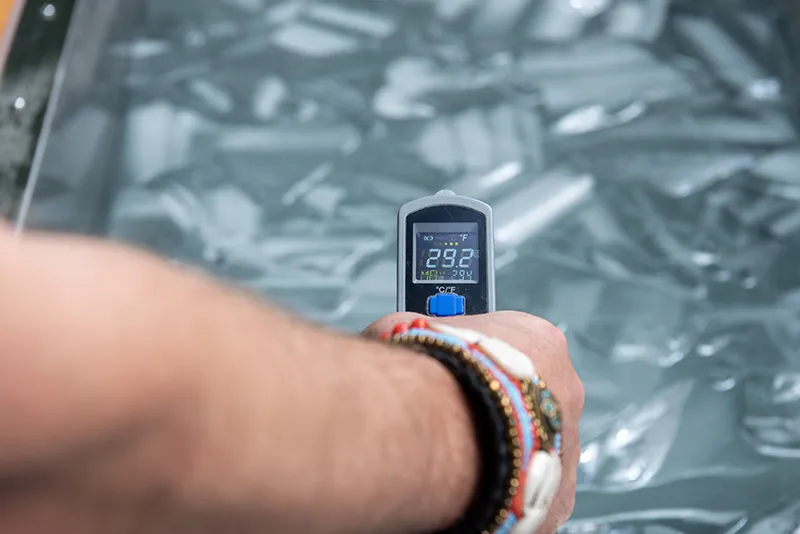
Measuring Cold Dose 📏❄️
Why do you cold plunge — pain relief, mental clarity, immune support, or simply the energized feeling afterward? Whatever your reason, each goal has an ideal combination of time and temperature, and understanding your cold dose helps you find it.
Thomas Seager, PhD, developed a simple method to calculate cold dose based on two variables: water temperature and time. To use it, begin by identifying your thermal comfort line — the temperature that feels neutral to your body (typically around 80°F/27°C). The difference between this number and your cold-water temperature is your delta.
Cold Dose = (Thermal Comfort Line – Water Temperature) × Time
Example:
Jordan’s comfort line is 80°F. In 48°F water, her delta is 32. Staying in for 3.5 minutes gives her a dose of 112.
If she wants the same dose in 40°F water, her delta becomes 40. She divides 112 by 40 and gets 2.8 minutes (about 2:48).
This formula helps you adjust time and temperature to keep your cold exposure consistent, allowing you to tailor your practice safely as you progress.
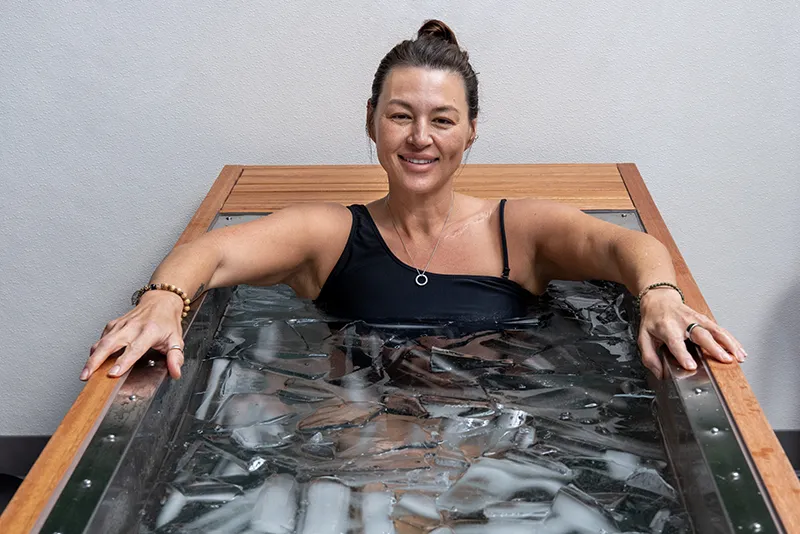
The Pendulating Method ⚖
Andrew Sheridan, founder of Dr!p Therm, developed a distinctive method he calls pendulating to teach beginners how to cold plunge by guiding them between sympathetic (fight-or-flight) and parasympathetic (rest-and-digest) states. He originally created the technique to treat his own neuropathy, which had left him without feeling in his left foot after Achilles tendon surgery.
Unlike methods focused on total cold dose, Sheridan emphasizes finding the temperature that triggers a gasp reflex and then coaching clients to regulate their breathing. Plungers begin in a sympathetic state, breathe themselves into a parasympathetic state, and repeat this cycle as they gradually submerge deeper. Each fresh wave of cold reactivates the sympathetic system, giving clients repeated practice in consciously shifting back to calm.
This pendulation may strengthen the nervous system’s ability to regulate stress — and in Sheridan’s case, it may even have contributed to the regrowth of damaged peripheral nerves. His approach may offer both psychological benefits for stress resilience and physiological benefits for nerve health.
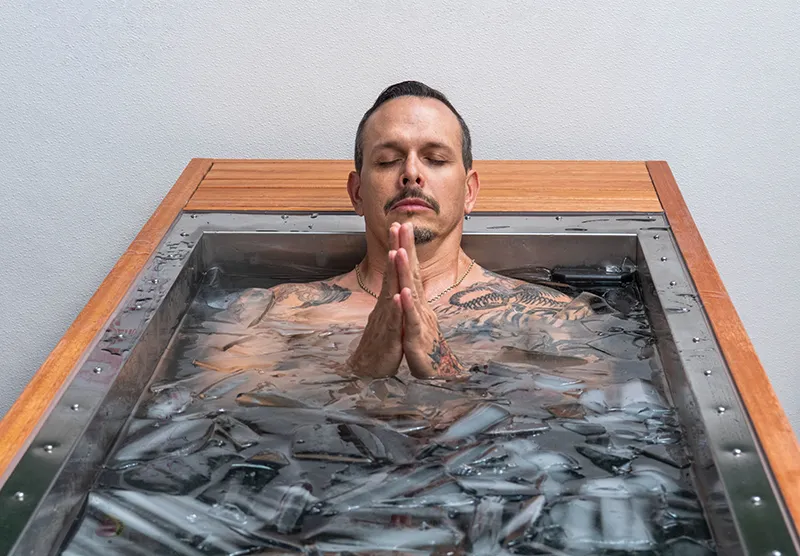
How Long Should You Stay In? ⏱
There’s no single “correct” amount of time to stay in a cold bath. For beginners, a simple guideline is to go cold enough to gasp and stay long enough to shiver. Shivering signals that your core temperature has dropped and that your body is generating heat to protect vital organs. As described in a previous article, vasoconstriction — the tightening of blood vessels to conserve heat — reduces inflammation and triggers hormonal responses that support immunity, tissue repair, and mood regulation. This makes the “cold enough to gasp, long enough to shiver” approach an effective starting point for harnessing both the physical and psychological benefits of cold exposure.
For more experienced plungers, the body adapts to colder conditions, making shivering a less reliable indicator of dosage. At this stage — or for those seeking deeper psychological benefits — a helpful guideline is to choose a temperature that frightens you. This maintains an appropriate level of challenge as your cold tolerance and stress tolerance grow.
Final Thoughts 💭
Whether you rely on cold dose calculations, the pendulation method, or based on intuitive cues, the key is to develop a cold-plunge practice that matches your goals and supports your well-being. With consistency, you’ll build not just cold tolerance but also resilience, emotional regulation, and a deeper connection to your body’s capacity to adapt. Cold plunging isn’t about enduring discomfort — it’s about learning from it.
Read and learn more about Morozko Forge! Their site is full of fascinating science and insights on cold baths❄️
Ready to start your own cold bath routine? Book a Contrast Therapy Circuit and start treating your body, mind, and well-being today!